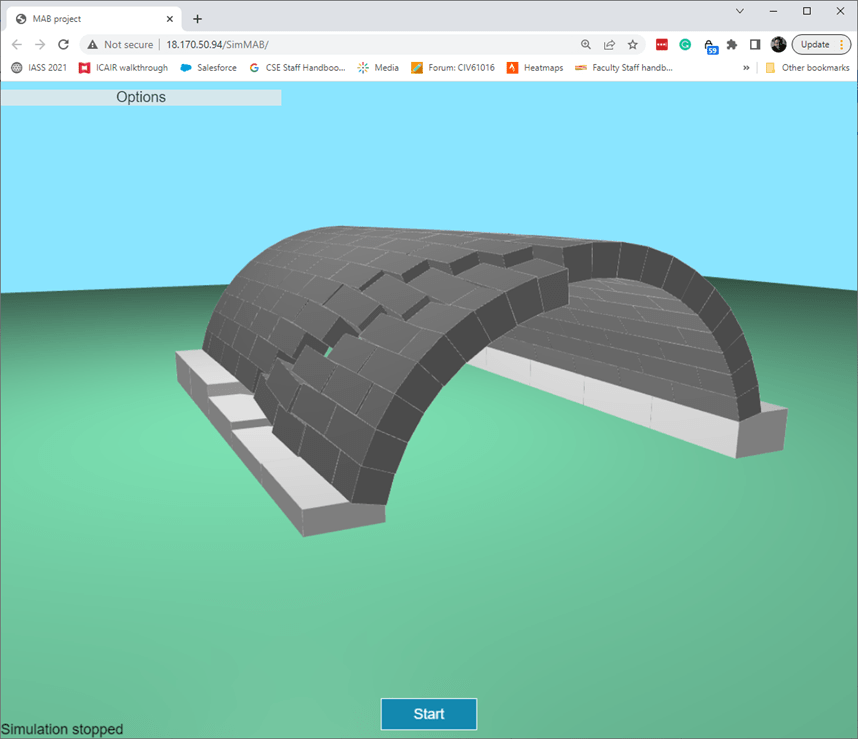
A new interactive web app has recently been developed as part of the ERMABI project, designed to demystify 3D modes of response in masonry arch bridges. This is now available for public testing via the following link.
Both square and skew span bridges can be investigated – and subjected to applied vertical loads and/or support settlements (applied by double-clicking on an abutment block and dragging it).
A two-day workshop is being held at Imperial College London on 5-6 September 2023. Speakers have been drawn from industry, institutions involved in the ERMABI project, and from other research organizations.
The workshop will provide an invaluable opportunity for participants to exchange knowledge and ideas on masonry arch bridge infrastructure.
Masonry arch bridges are long-lived structures that continue to form a vital part of our transport infrastructure. However, inaccurate assessment can lead to masonry arch bridges being needlessly infilled or demolished and replaced, at great cost to the planet.
ERMABI Principal Investigator Professor Matthew Gilbert and co-investigator Dr Colin Smith are co-authors of new CIRIA guidance on the assessment of masonry arch bridges. The guidance, CIRIA C800, builds on recent research findings and advice already available in CIRIA C656, DMRB and Network Rail codes. Specifically, the guidance promotes the use of the Permissible Limit State (PLS), the point beyond which progressive load-induced degradation occurs under service loads during the intended life of a bridge.
The guidance, which can be freely downloaded from the CIRIA website, was announced on June 8 2022 at the NCE Future of Bridges event and was formally launched at an event held at the Institution of Civil Engineers in London on 30 June 2022 – this included a presentation by Matthew Gilbert and contributions from ERMABI project partners Peter Sparkes (AECOM) and Jon Shave (WSP). A recording of the event is now available:
 ERMABI - Exploiting the Resilience of Masonry Arch Bridge Infrastructure